
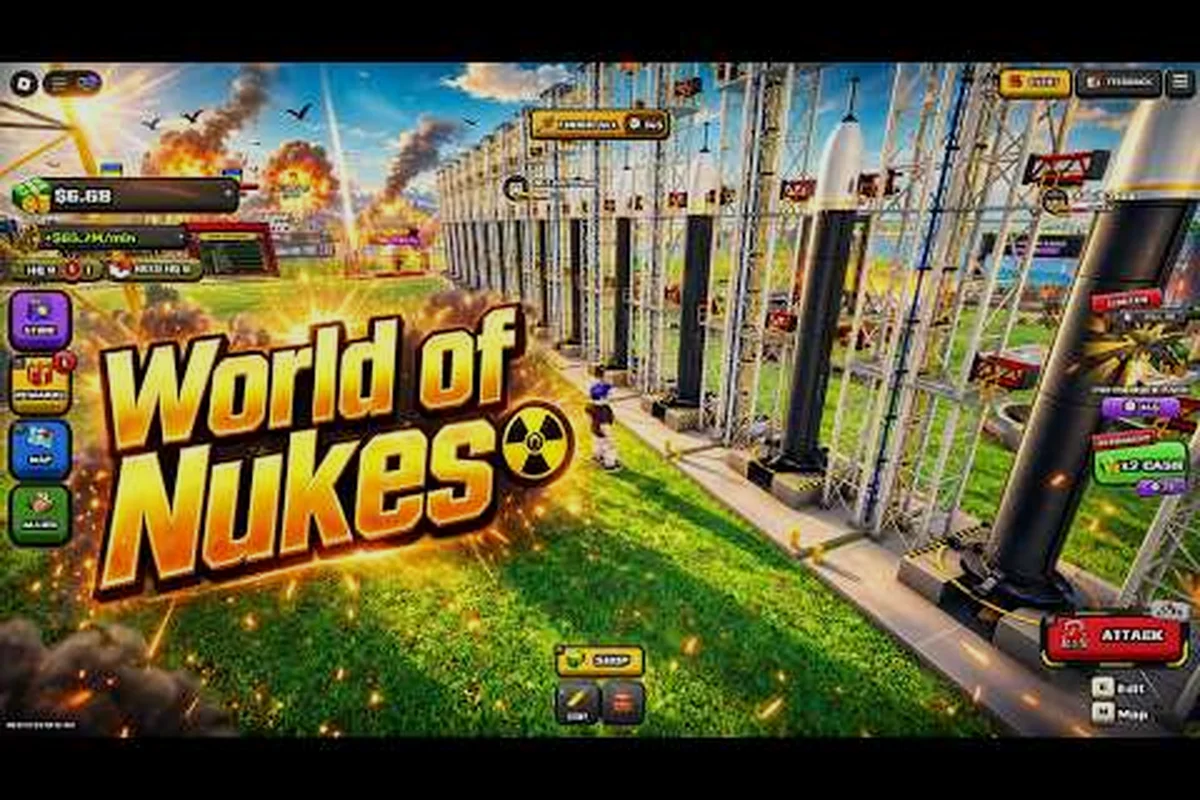
Reaching superpower status in World of Nukes is not about launching the biggest missile first — it is about building an economy that can afford to lose one. This superpower guide breaks down how wonders and megastructures fund the end-game nukes that decide world domination.
The gap between a mid-game island and a true superpower is measured in income per minute, not warheads. Players who rush missiles usually stall out around the second expansion because their base cannot replace what they fire. The fix is structural: stack passive income from wonders, convert that surplus into megastructures, and only then open the nuclear phase of the run.
Why Superpower Status Is an Economy Problem First
Every late-game system in World of Nukes draws from the same pool of cash and build slots, so the order you spend them defines your ceiling. According to the official World of Nukes page on Roblox, the loop is island expansion, missile deployment, jets, warships, anti-air, and shields — with the Doomsday Device and wonders listed as late-game milestones. That description alone tells you the developers expect players to build infrastructure before firepower.
| 时间节点(新开局) | 应投入的经济项 | 应暂缓的军事项 | 判定依据 |
|---|---|---|---|
| 0–10 分钟 | 收入建筑升级(camp → 岛屿扩张前置) | 导弹发射井 | 社区录像(Newbie to Roblox,2026-10-31)显示首次导弹发射约在第 10 分钟 |
| 10 分钟基准点 | 收入建筑二次升级、岛屿扩张 | 第二枚导弹、喷气机 | 发射成本若挤占未存入的升级,等于用永久收入倍率换一次性弹头 |
| 收入/分钟 ≥ 单枚导弹替换成本 | 防空(anti-air) | 战舰 | 防空保护已建成的收入建筑,是防御性支出而非进攻性支出 |
| 收入/分钟 ≥ 导弹 + 防空总成本 | 护盾(shields) | 奇迹(wonders) | 官方页面将 wonders 与 Doomsday Device 列为后期里程碑,须在可用基地上叠加 |
| 收入曲线稳定后 | Doomsday Device 前置、奇迹 | — | 奇迹与巨型结构只放大已运转的基地,不拯救空转的发射井 |
Community footage captured by Newbie to Roblox shows the first missile launch landing at roughly the ten-minute mark of a fresh run, which is a useful benchmark. If you are firing before your income buildings are upgraded, you are spending your seed corn.
The practical rule experienced players follow: treat your island like a compounding investment, where every dollar routed into income buildings during the first ten minutes returns multiples by the time the Doomsday Device becomes relevant. Concretely, if a missile launch at the ten-minute benchmark costs you an upgrade you have not yet banked, you have traded a permanent income multiplier for a single-use warhead — a losing exchange in any world domination guide. Veterans therefore cap early military spending at what defense actually requires, bank the surplus into economy, and only reopen the offense budget once income-per-minute outpaces the cost of replacing losses.
-
Income buildings first — they fund every later expansion and never stop paying.
-
Defense second — anti-air and shields protect the income you already built.
-
Offense third — missiles and warships pay for themselves only after the economy is stable.
-
Wonders and megastructures last — they multiply a base that already works.
That sequencing is the backbone of any world domination guide worth reading, because it prevents the most common failure: a beautiful missile silo with nothing left to fuel it. In World of Nukes terms, a silo built ahead of your income curve forces you to choose between firing and upgrading, and every second that silo sits idle is wasted build slot and upkeep. Veterans instead let the economy compound until income-per-minute comfortably covers a replacement missile, then layer anti-air and shields over the income buildings they already own — so when the Doomsday Device and wonders finally unlock, you are multiplying a working base rather than mortgaging one.
Wonders: The Multiplier Layer of Your Island
Wonders are the first genuine power spike in the game, and they are the reason a well-planned island out-earns a bigger one. Each wonder occupies a build decision rather than a build slot alone, so placement and timing matter as much as the purchase price.
How Wonders Change Your Income Curve
A wonder does not simply add flat cash — it changes the rate at which every other building pays out. That compounding effect is why players who buy wonders early finish their island expansion noticeably faster than players who buy a second missile type. The tradeoff is that a wonder produces nothing defensively, so buying one during an active raid is a losing move.
Treat wonders as a peace-time purchase, not a panic button. Queue the build only once your shield coverage is up and your anti-air umbrella is complete, because a wonder under construction is dead weight if a raid slips through. The practical timing cue is your income-per-minute readout: start the queue when that number has been flat for a full cycle, meaning your economy has plateaued and the wonder's multiplier is the cheapest next step. Then route the income spike straight into the next tier of structures — upgrade your resource extractors first, since the wonder's percentage boost scales off their base output, and only then spend on additional silos or launch capacity. Players who instead dump the spike into more nukes often stall, because raw warheads without the upgraded economy behind them can't sustain a second build queue.
Wonder Timing Benchmarks
| Run Stage | Typical Income State | Wonder Decision | Risk Level |
|---|---|---|---|
| First 10 minutes | Single income cluster | Skip — upgrade income buildings | Low |
| Early expansion | Two income clusters | Buy the cheapest wonder available | Medium |
| Mid expansion | Stable, defended base | Stack a second wonder | Medium |
| Pre-nuclear | Wonders online, shields up | Hold cash for megastructures | High |
| End game | Megastructures running | Wonders are already paid off | Low |
The table above reflects community-reported pacing rather than official numbers, so treat the timing as a range and adjust to your server's economy. The wonder and nuke launch breakdown covers individual wonder unlocks in more detail if you want to plan a specific purchase order.
Megastructures: Converting Wonders Into an End-Game Engine
Megastructures are where a strong island becomes a superpower. They cost far more than wonders, take longer to come online, and are almost impossible to justify before your wonder income is flowing. Once they are running, though, they generate the surplus that makes an end-game arsenal affordable.
The Megastructure Payback Test
Before committing to any megastructure, run a simple payback check: divide the total cost by the income it adds per minute. If the result is longer than the remaining length of a typical session on your server, the structure is a vanity project. Players report that the structures worth building are the ones that pay back inside a single sustained session, because those are the ones that actually fund your nukes.
Three practical habits separate successful megastructure builds from wasted ones: sequence your spend so the cheapest payback structure (usually a tier-1 income wonder) lands first and funds the next, since chaining two short-payback builds beats saving for one expensive megastructure; keep a reserve equal to roughly one session's nuke production so a surprise raid never forces you to sell the structure mid-payback; and time construction to your server's active hours, because a megastructure that finishes while you are offline spends its first payback window undefended.
-
Build behind shields. A megastructure under construction is the single most attractive target on your island.
-
Never build two at once. Split income between two half-finished projects and neither pays back in time.
-
Pair with defense upgrades. Every megastructure purchase should be followed by an anti-air or shield refresh, because your island's value just went up.
The broader late-game progression guide walks through how megastructures fit into the full upgrade ladder, including which ones to skip entirely on short sessions. The rule of thumb it applies: a wonder that only breaks even after 40+ minutes of uninterrupted income is dead weight on a 20-minute session, so tier-1 income wonders that pay back in under 15 minutes should always be your first pick, with expensive prestige megastructures reserved for servers running long, populated sessions where your reserve and shield refresh can actually cover the payback window.
Building the End-Game Nuke Arsenal
This is the payoff phase. Once wonders and megastructures are generating surplus, the question shifts from "can I afford a nuke" to "which nuke solves my problem." World of Nukes end game nukes are not interchangeable, and firing the wrong one is how superpowers lose momentum.
Matching Warheads to Targets
| Warhead Role | Best Used Against | Cost Profile | When to Fire |
|---|---|---|---|
| Standard missile | Income clusters, exposed builds | Low, repeatable | Any time you have surplus |
| Heavy strike | Shielded or dug-in islands | High, slow rebuild | After scouting defenses |
| Precision option | Single high-value structure | Medium | When you can confirm the target |
| Doomsday Device | Decisive late-game pressure | Very high, one-shot | Only when the run is already won |
The Doomsday Device deserves its own warning. It is the headline item on the official game page and the most expensive thing you will ever build, but it does not create advantage — it converts an advantage you already have into a finish. Firing it while your economy is still fragile leaves you with a crater and no income.
Defense Is Part of the Arsenal
A superpower that cannot absorb a counterstrike is not a superpower. Anti-air coverage and shields are the reason your megastructures survive long enough to pay for themselves, and they are cheap relative to the structures they protect. Community gameplay consistently shows that islands with layered anti-air recover from raids in minutes, while undefended islands lose entire income clusters in a single exchange.
If you are still working out how the whole loop fits together, the guide to becoming a superpower explains how features unlock across a run, which helps you time your first wonder purchase correctly.
A Step-by-Step World Domination Path
Putting the pieces in order is what separates a plan from a wish list. The sequence below is the shortest reliable route from a starting camp to a dominant island, following the official milestone structure that gates wonders, megastructures, and the end-game nukes behind fixed build requirements. Each step assumes the previous one is finished — skipping ahead, like buying your first wonder before your income clusters are capped, is the single most common way a promising run collapses into a rebuild.
-
Establish two income clusters before buying anything optional. One cluster cannot survive a raid.
-
Upgrade income buildings to their practical cap. Cheap upgrades with fast payback beat expensive purchases every time.
-
Layer anti-air and shields around the income you have built. Defense protects the engine.
-
Buy your first wonder during a quiet window, not mid-raid.
-
Stack a second wonder once the first has paid for itself.
-
Start one megastructure and finish it before starting another.
-
Refresh defenses immediately after the megastructure completes.
-
Open the nuclear phase with standard missiles against exposed targets.
-
Escalate to heavy strikes only when you can afford to replace them.
-
Hold the Doomsday Device until the run is effectively decided.
Steps 1 through 4 are where most runs are won or lost, because everything after them is a multiplier on the income engine you built early. A player who reaches step 5 with both income clusters capped and shields layered will out-scale a player who rushed to step 8 with a broken base almost every time — the second player is spending missiles to defend buildings that should have been upgraded two steps ago. Concretely, the gap shows up in rebuild cost: a raided cluster means re-buying income buildings at full price while your rival is already stacking a second wonder, and that swing is usually unrecoverable before the Doomsday Device window opens.
What World Domination Actually Looks Like
World domination in this game is not a single button — it is the state where your income outpaces every rival's ability to rebuild. That means your missiles can keep firing while theirs cannot, and your shields absorb what they send back. The 2026 nuke strategy overview covers the win condition in more depth, including how arsenal size interacts with sustained pressure.
Common Mistakes Players Make on Superpower Runs
Most stalled runs share the same handful of causes, and all of them are fixable within a single session. In practice, the failure is rarely a single catastrophic decision — it is a compounding leak. A player who buys missiles before securing income, skips wonders to bank cash, or expands without anti-air coverage is quietly trading long-term world domination potential for short-term board presence. Each mistake looks small in isolation, but together they explain why a superpower run that felt dominant at turn 40 collapses by turn 80, when the opponent's completed megastructures and Doomsday Device timer leave no room to recover.
-
Buying offense before income. Missiles are consumable; income is permanent.
-
Building a megastructure without shield coverage. You are funding your opponent's best target.
-
Skipping wonders entirely. You save a little cash and lose the multiplier that funds everything after.
-
Firing the Doomsday Device early. It ends runs; it does not create advantages.
-
Neglecting anti-air after expansion. Every new structure raises the value of what a raid can take.
The pattern behind all five is the same: spending on the visible, exciting option instead of the compounding one. A missile launch is a one-time payout with no production multiplier behind it, while a wonder keeps feeding your economy every turn it stands — so the player who fires first often loses the income race by the mid-game. Wonders and megastructures are less dramatic than a missile launch, but they are what makes the launch repeatable.
Frequently Asked Questions
What should I build first in World of Nukes to reach superpower status?
Start with income buildings and upgrade them before buying anything optional. Income funds island expansion, defense, and eventually your nuclear arsenal, so it is the foundation of every superpower run. Community footage shows the first missile launch around ten minutes in, which is a reasonable benchmark for when offense becomes affordable.
Are wonders or megastructures more important?
Both matter, but in order. Wonders come first because they multiply your existing income and pay back quickly, which then makes megastructures affordable. Buying a megastructure before your wonder income is flowing usually results in a half-finished project that never pays for itself.
When should I fire the Doomsday Device?
Only when the run is already effectively decided in your favor. The Doomsday Device is the most expensive item in the game and converts an existing advantage into a finish rather than creating one. Firing it while your economy is still fragile leaves you unable to rebuild.
How many nukes do I need for world domination?
There is no fixed number, because domination depends on outpacing rivals' ability to rebuild rather than hitting a count. What matters is sustained income that lets you keep firing standard missiles while your shields absorb counterstrikes. Arsenal size follows economy, not the other way around.
Do I need anti-air and shields before expanding?
Yes. Every expansion raises the value of what a raid can take from you, and undefended income clusters can be erased in a single exchange. Layered anti-air and shields are cheap relative to the structures they protect and are what let a superpower recover from raids in minutes.
Reaching superpower status in World of Nukes comes down to sequencing: income before defense, defense before offense, wonders before megastructures, and megastructures before the end-game nukes that finish the job. Build the economy that can afford to lose a warhead, and world domination stops being a gamble and becomes a schedule.