
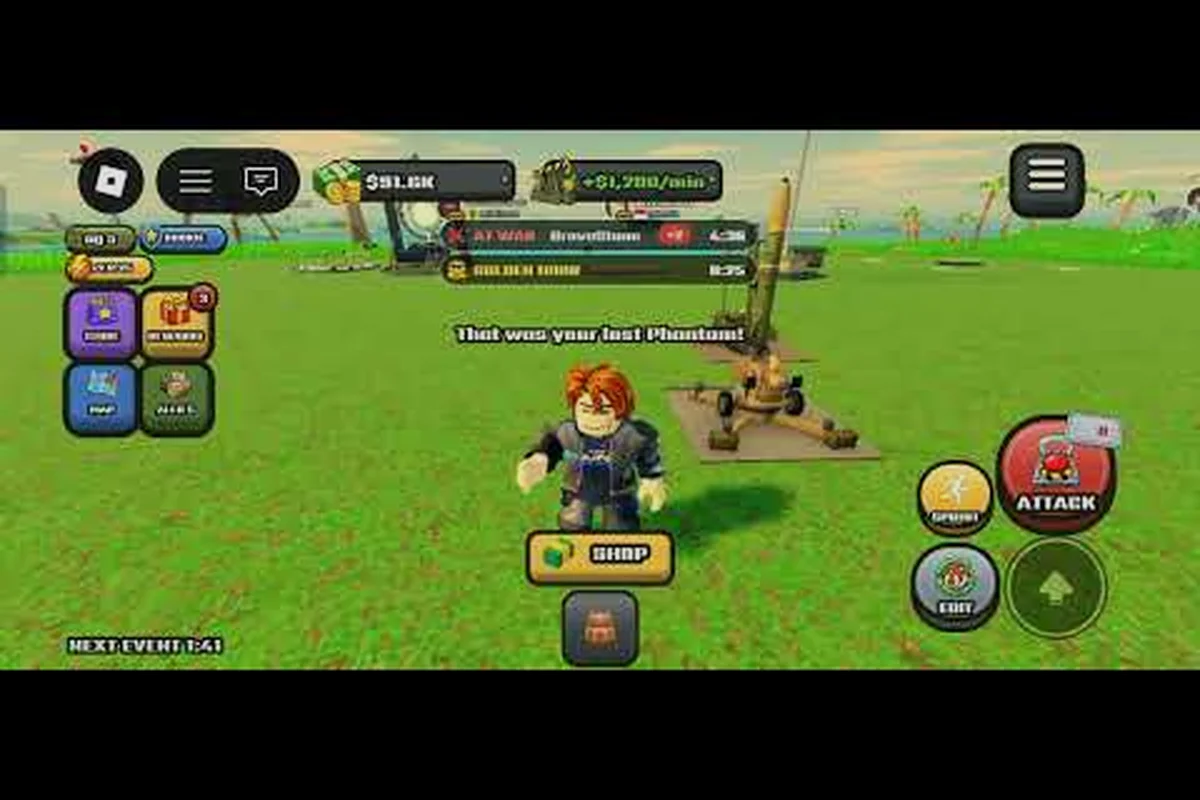
A solid World of Nukes walkthrough matters because the game punishes random spending: your camp stalls out fast if income buildings come last. This guide traces the exact build order and missile unlocks that carry you from a tiny camp to a functioning mid-game island nation, so you always know what to buy next.
World of Nukes is a Roblox island-nation tycoon from the Build. Defend. Nuke. group, and the official Roblox page frames the whole loop around one idea: grow a small camp into a superpower by expanding the island, deploying missiles, flying jets, commanding warships, and layering anti-air and shields on top. That description is accurate, but it hides the ordering problem that trips up most new players. The game does not tell you which purchase pays for the next one, so people buy a launcher they cannot afford to feed or expand the island before their economy can support the upkeep.
This World of Nukes tutorial fixes that by treating progression as a chain of dependencies. Every purchase should either raise income or unlock something that raises income. Offense is a tool for protecting income, not a substitute for it. Community gameplay footage from a first-join-to-mid-game run shows the first missile launch landing at roughly the ten-minute mark, which is a useful benchmark: if you are past fifteen minutes with no missile and no stable income, your build order drifted.
The sections below cover the opening camp layout, the income-first build order, the missile unlock ladder, defensive essentials, and the mid-game transition where your island starts to look like a nation instead of a sandbar. Treat it as a route map rather than a rigid script, because island layouts and lobby conditions vary between servers.
Opening Camp Layout and the First Ten Minutes
The first ten minutes decide whether your run feels smooth or constantly cash-starved. Your starting camp is small, and every early purchase competes for the same limited pool of money, so the opening is really a sequencing puzzle. The safest pattern is to place income buildings before anything with a combat function, because income compounds while combat structures sit idle until someone attacks you.
Community footage of a clean early run shows a simple layout: income structures clustered near the spawn area where you can reach them quickly, with expansion space left open toward the shoreline. Do not fill your starting plot with decorative or defensive pieces, because you will want that footprint for the next tier of income buildings. Keeping a clear lane also makes it easier to spot where new structures can drop without blocking your own movement.
Here is a practical opening checklist that mirrors what experienced players do in the first few minutes:
-
Buy the cheapest income building first and let it run while you scout the island layout.
-
Reinvest every payout into another income structure rather than saving toward a big unlock.
-
Skip combat structures until your income covers their upkeep without stalling growth.
-
Leave open ground near the shoreline for later expansion and launch infrastructure.
-
Check the map for where other players are building so you know which direction is contested.
A common mistake is treating the first missile as the goal of the opening. It is not. The first missile is a milestone that proves your economy can support a launch, and rushing it before that point leaves you with a weapon and no way to replace what you spent. The starting guide covers the same opening window in more detail if you want a second pass on the first few purchases.
| Opening Phase | Time Window | Primary Purchase | Goal |
|---|---|---|---|
| Seed income | 0-3 min | Cheapest income building | Get money flowing |
| Compound | 3-6 min | Second and third income buildings | Raise payout rate |
| Stabilize | 6-9 min | Income upgrade tier | Cover basic upkeep |
| First launch | ~10 min | Entry missile structure | Prove economy works |
| Expand | 10+ min | Island expansion | Unlock new build space |
The table is a target, not a law. Lobbies with aggressive neighbors may force you to buy a cheap defensive piece earlier than planned, and that is fine as long as you return to income immediately afterward. The principle that matters is that defense exists to protect income, never to replace it.
Income-First Build Order That Actually Scales
Income is the spine of any World of Nukes walkthrough, because every later system in the game is gated behind money. Missiles cost money to build and money to replace. Jets and warships cost money to field. Anti-air and shields cost money to maintain. If your income curve is flat, all of those systems become one-time purchases you cannot sustain, and a single bad fight wipes out progress you spent ten minutes accumulating.
The build order that scales looks like a staircase rather than a spike. Each step raises your payout rate enough to justify the next step, and you never take a step you cannot afford to repeat. Players who try to jump two tiers at once usually end up selling or abandoning structures to recover, which wastes both money and time.
| Income Tier | Typical Cost Band | Payback Feel | When to Buy |
|---|---|---|---|
| Entry income building | Low | Fast | Immediately at spawn |
| Second income building | Low-mid | Fast | After first payout |
| Income upgrade | Mid | Moderate | Once two buildings run |
| Mid-tier income structure | Mid-high | Moderate | After first missile |
| Expansion-funded income | High | Slow but large | Mid-game transition |
Two habits separate players with healthy economies from players who constantly rebuild. The first is reinvesting on payout instead of hoarding toward a distant unlock, because money sitting idle is money not compounding. The second is resisting the urge to buy combat structures during quiet stretches; a launcher that never fires is dead capital, while an income building keeps paying regardless of what happens on the map.
There is a real tradeoff here, and it is worth naming. Pure economy play leaves you exposed if a neighbor decides to test your defenses early. The compromise most strong players use is a single cheap defensive piece placed to cover the income cluster, bought only after the second income building is running. That one purchase buys enough safety to keep compounding without derailing the curve.
If you play on a phone or tablet, the input differences change how quickly you can cycle purchases, and the mobile guide explains how to keep the same income-first rhythm with touch controls. On PC, hotkey familiarity is the main advantage, which is why a dedicated World of Nukes PC guide angle focuses on fast menu navigation rather than different mechanics.
Missile Unlock Ladder and When to Launch
Missiles are the identity of the game, and the unlock ladder is where most players want to rush. The smarter approach is to treat each missile tier as a reward for an economy milestone rather than a goal in itself. When your income comfortably covers a launch plus a replacement, you are ready for that tier. When it does not, you are buying a trophy.
The first launch is the clearest benchmark in the whole progression. Community gameplay captured from a fresh join shows the first missile going up around the ten-minute mark in a well-paced run, which lines up with the income-first build order above. If your first launch happens much later, the usual cause is spending on defense or expansion before income stabilized.
| Missile Tier | Unlock Feel | Economy Prerequisite | Best Use |
|---|---|---|---|
| Entry missile | Early | Stable single-source income | Learning launch flow |
| Second tier | Early-mid | Two income buildings running | Pressure nearby camps |
| Area missile | Mid | Income upgrade complete | Punishing clustered builds |
| Heavy missile | Mid-late | Expansion-funded income | Decisive strikes |
| Doomsday-tier | Late | Full economy plus wonders | End-game dominance |
Each tier changes what you can threaten, but none of them change the underlying rule: a missile you cannot replace is a missile you should not fire. Firing early feels satisfying and often nets a quick hit on a careless neighbor, but if the retaliation costs you three income buildings, the exchange was a loss. Save launches for moments when the target's rebuild cost exceeds yours, or when you are clearing space for your own expansion.
The superpower guide picks up where this ladder ends, covering the Doomsday Device and wonder-tier milestones that the official page lists as late-game goals. Getting there requires the mid-game economy described in the next section, because late-game structures are expensive enough that a shaky income base collapses under their cost.
Defensive Essentials: Anti-Air, Shields, and Jets
Defense in World of Nukes is not about building a wall and hiding. It is about making an attack unprofitable for the attacker. That framing changes what you buy: instead of stacking the strongest single defensive structure, you layer cheap coverage that forces an attacker to spend more than they gain. Anti-air handles incoming aircraft, shields absorb or blunt missile hits, and jets give you a mobile response that does not sit idle.
The essentials list for a mid-game island looks roughly like this:
-
Anti-air coverage over your income cluster, since that is what attackers target first.
-
A shield layer placed to protect the highest-value structures rather than the perimeter.
-
One or two jets for scouting and intercepting, not for solo raids.
-
Warship presence near contested water if your island sits on a busy lane.
-
Redundant income placement so a single strike cannot cripple your whole economy.
Redundancy is the piece most players skip. If all your income lives in one tight cluster, one area missile erases your entire economy and you spend the next several minutes rebuilding from nothing. Spreading income across two clusters costs a little efficiency in the early game but pays for itself the first time someone lands a lucky hit.
Jets deserve a specific note because they are the most commonly misused purchase. A jet is a scouting and interception tool, not a substitute for missiles. Flying one across the map to poke at a neighbor usually ends with the jet destroyed and the neighbor now aware of exactly where you live. Use jets to watch approaches and to contest aircraft, and let missiles do the actual damage.
Shields and anti-air also interact with the missile ladder in a way that is easy to miss. Once you unlock area missiles, your neighbors will too, which means the value of shields rises sharply at exactly the moment you start wanting to spend on offense. Buying a shield tier right after your first area missile unlock is usually a better investment than buying a second offensive structure.
Mid-Game Transition: Turning a Camp Into a Nation
The mid-game transition is where World of Nukes stops feeling like a tycoon and starts feeling like a nation builder. Island expansion opens new build space, which lets you separate income from defense from launch infrastructure instead of cramming everything into the starting plot. That separation is the real reward of expansion, more than the raw space itself.
The transition has a recognizable shape. Your income is stable enough that you are no longer checking the balance before every purchase. You have at least one missile tier unlocked and can replace launches without stalling growth. Defensive coverage exists but does not dominate your spending. At that point, expansion becomes the correct next investment because it unlocks the structures that carry you into the late game.
| Mid-Game Milestone | Signal You Are Ready | What It Unlocks |
|---|---|---|
| First expansion | Stable income, replaceable missiles | New build plots |
| Second income cluster | Expansion plot secured | Attack-resistant economy |
| Shield tier upgrade | Neighbors have area missiles | Survivability |
| Warship deployment | Contested water nearby | Map control |
| Wonder prep | Economy covers large projects | Late-game path |
A practical mid-game routine keeps you from drifting. Check your income rate, confirm your missile tier is replaceable, then spend the surplus on expansion or a shield upgrade, alternating between the two. Alternating prevents the classic mid-game failure where a player over-invests in offense, gets flattened by a neighbor with shields, and then cannot afford to rebuild either the offense or the defense.
The new player guide covers the first hour in detail, and its early-game section pairs well with this transition point because the habits you build in the first ten minutes determine whether the mid-game feels comfortable or chaotic. Players who reinvested consistently find expansion almost effortless, while players who hoarded or over-bought combat structures arrive at the same moment with nothing to spend.
One more mid-game essential: keep a reserve. A reserve equal to roughly one missile replacement plus one income building lets you absorb a bad exchange without derailing your curve. Players who spend to zero every time they have money are the ones who collapse after a single lost fight, because they have no buffer to rebuild from.
Frequently Asked Questions
How long should the early game take in World of Nukes?
A well-paced run reaches its first missile around the ten-minute mark, based on community gameplay footage from a fresh join. If you are past fifteen minutes without stable income and a launch, your build order likely prioritized combat or expansion too early. Return to income buildings before buying anything else.
Do I need to buy defense before my first missile?
Usually no, beyond one cheap defensive piece covering your income cluster. Early lobbies are rarely aggressive enough to justify heavy defense spending, and every dollar in a shield is a dollar not compounding in income. Buy real defensive layers after your first missile unlock, when neighbors start having area weapons.
What are the World of Nukes essentials for a mid-game island?
Stable replaceable income, at least one unlocked missile tier, anti-air over your income cluster, a shield layer protecting high-value structures, and a reserve equal to one missile replacement. Redundant income placement matters too, since a single area missile should not be able to erase your entire economy.
Can I play the same build order on mobile?
Yes, the income-first sequence works identically on touch controls; only the speed of menu navigation changes. Mobile players should practice cycling purchases quickly during quiet stretches so that a busy moment does not stall their reinvestment rhythm. The core rule stays the same: income before offense, always.
When should I start expanding the island?
Expand once your income is stable enough that you no longer check the balance before routine purchases, and once your current missile tier is replaceable. Expanding earlier stretches your economy thin and leaves new plots undefended. Expanding later wastes compounding time, since expansion-funded income is the largest jump available in the mid-game.
The through-line of this World of Nukes walkthrough is simple: income funds everything, missiles are rewards for economic milestones rather than shortcuts, and defense exists to protect the economy rather than replace it. Follow that order from the opening camp through island expansion, and the mid-game transition stops being a wall and becomes the point where your island finally starts acting like a nation.