
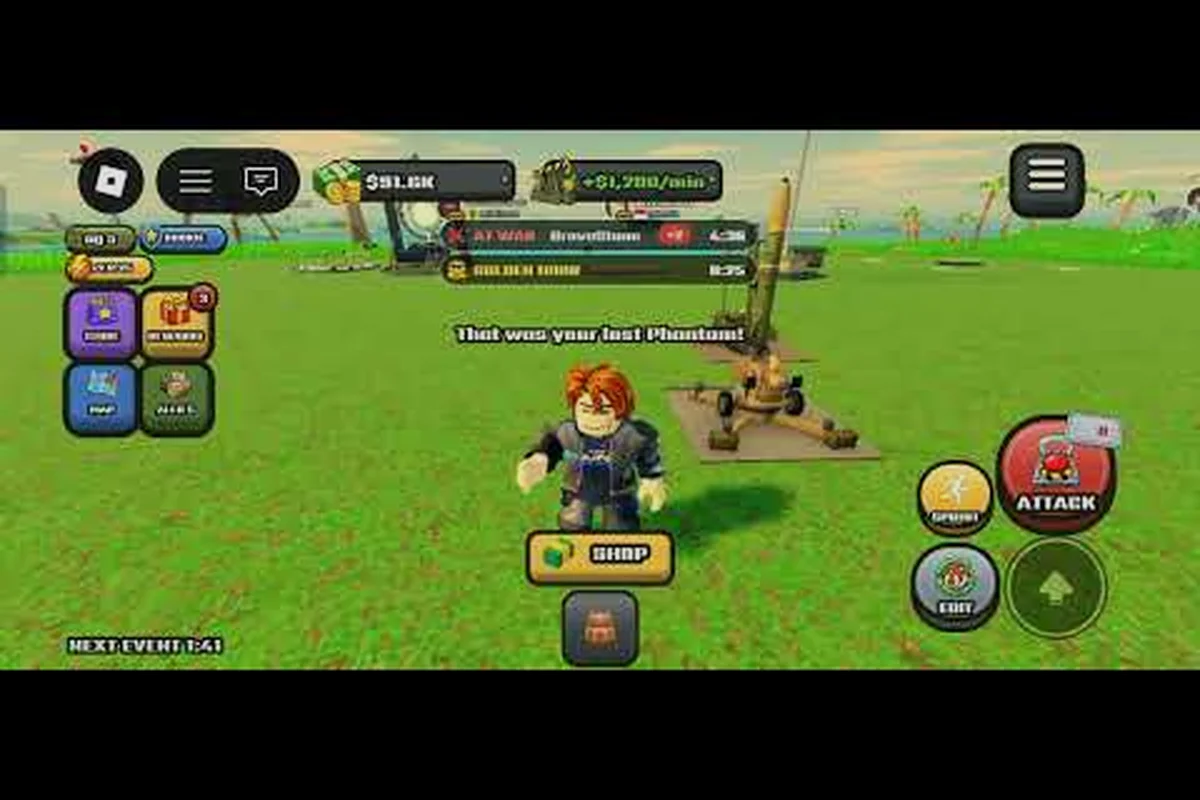
The tutorial in World of Nukes is not optional busywork — it is the gate that unlocks your codes menu and teaches the build-and-fire loop you will repeat for hours. This World of Nukes starting guide walks you from a tiny camp to your first reliable income stream, so you stop guessing and start compounding cash.
Most new players lose their opening minutes to wandering instead of building. The fix is simple: finish the tutorial, place income structures, and only then think about missiles. Get that order right and the rest of the game opens up fast.
Why the Tutorial Comes First in Any World of Nukes Guide
The single most common early mistake is skipping or rushing the opening tutorial. According to the official World of Nukes Roblox page, the tutorial teaches the core building and missile loop and is required to unlock the codes menu. That last part matters more than it sounds — the codes menu is where free boosts and rewards live, and you cannot touch it until the tutorial is done.
Here is what the tutorial actually hands you, in order — and each step maps to a mechanic you will reuse for the rest of your run, so it is worth knowing what is coming before you click through it. The opening placement lesson teaches the valid-ground rule that governs every future building, the cash flow step introduces your first income structure and explains why spending on offense before income stalls your mid-game, and the guided missile launch walks you through a full strike cycle without letting you drain your starting balance. The final step unlocks the codes menu, the same panel the official game page ties to the tutorial requirement.
-
Placement basics — how to drop buildings on valid ground without wasting cash on bad spots
-
Cash flow introduction — your first income building and why it pays before anything else
-
The missile loop — a guided first launch so you understand offense without burning early savings
-
Codes menu unlock — the reward panel that stays locked until the tutorial completes
Skipping the tutorial does not save time; it locks a reward system behind you and leaves you guessing at placement rules. Treat the first ten minutes as an investment, not a delay. The math is simple: every minute spent inside the guided sequence is a minute you are not spending on a misplaced building that drains your starting cash, and a bad placement early can cost you the income ramp you need before your first missile strike. Because the codes menu stays locked until the tutorial completes, skipping it also means forfeiting the free boosts that would otherwise offset your opening build costs — a trade that never pays off. Players who click through the placement and cash flow steps once tend to hit their first missile launch faster than those who learn the valid-ground rule by trial and error, since the tutorial hands you the rule for free instead of charging you in wasted structures.
What "Finishing the Tutorial" Actually Means
Finishing means completing every guided step until the game stops prompting you, not just placing one building and leaving. Community footage of a fresh session shows the first missile launch landing at roughly the ten-minute mark when players follow the prompts without detours. If you are well past that and still have no missile prompt, you likely missed a placement step — walk back through the objectives list rather than restarting.
The World of Nukes Beginner Tutorial: Build Order That Pays
Once the tutorial ends, you own a small camp and a decision: spend on offense or spend on income. The answer is income, every time. Income buildings fund every later expansion, while offense only pays for itself after your economy can absorb the cost. A World of Nukes quick guide that tells you to rush missiles is quietly setting you up for a stalled mid-game.
| Priority | Build Type | Why It Comes Here | Rough Timing |
|---|---|---|---|
| 1 | First income building | Generates the cash that pays for everything else | Immediately after tutorial |
| 2 | Second income building | Doubles your earning rate before upgrades get expensive | First few minutes |
| 3 | Income upgrade | Cheaper per dollar earned than a brand-new building | Once base income is steady |
| 4 | Defensive structure | Protects what you have built from early raids | Before your first real fight |
| 5 | First offensive missile | Only after income covers the rebuild cost | After economy is stable |
The logic is straightforward: every dollar spent on offense early is a dollar not earning interest. Players who stack two or three income buildings before their first missile consistently reach island expansion faster than players who fire first and rebuild later.
Reading Your Cash Rate Before You Spend
Before any purchase, glance at your income per second and ask whether the new building pays for itself within a reasonable window. If a building costs more than several minutes of your current income, it is probably an upgrade target rather than a fresh purchase. This one habit separates smooth runs from grindy ones, and it is the core lesson behind most beginner tips and tricks that experienced players pass along.
Placing Income Buildings Without Wasting Space
Space is finite and placement is permanent enough to matter. The tutorial shows you valid ground, but it does not warn you about crowding. Leave breathing room between income buildings so later upgrades and defensive structures have somewhere to go. A camp packed shoulder-to-shoulder looks efficient and then blocks your own expansion.
Three placement rules worth internalizing: keep income buildings within a tight cluster so a single defensive line can later shield them, but leave at least a one-tile gap between structures so upgrade footprints and turret placement do not collide; carve out a dedicated defense lane between your economy and the map edge where attackers spawn, giving your turrets a clear firing buffer; and never build across your only expansion path, since boxing in your island with a wall of structures can stall growth before you can afford to demolish and rebuild.
-
Keep income buildings clustered but not touching — grouping simplifies defense later without locking your layout
-
Reserve a clear lane for defenses — you want a buffer between your economy and the map edge where attackers arrive
-
Do not build on your only expansion path — island growth needs room, and a wall of buildings can box you in
If you have already made a mess of your layout, do not panic. Early buildings are cheap enough to relocate relative to your total income, and the cost of a slightly awkward camp is far lower than the cost of a stalled economy.
The Building-to-Upgrade Crossover Point
There is a crossover point where new buildings stop being the best use of cash and upgrades take over. As a rule of thumb, once a fresh income building costs more than roughly three times your current per-second income, pivot to upgrading what you already own. Upgrades scale your existing footprint instead of demanding new space, which keeps your camp compact and your defense simpler.
Your First Missile: Timing It Right
The first missile is a milestone, not a starting move. Fire it too early and you drain the savings that were supposed to fund your second income building. Fire it at the right moment and it becomes a cheap lesson in how offense works before the stakes get high.
| Signal You Are Ready | What It Looks Like | Why It Matters |
|---|---|---|
| Steady income | Cash keeps climbing even while you spend | You can absorb the missile cost |
| Rebuild buffer | You can replace a lost building without stalling | One bad exchange will not cripple you |
| Defenses in place | At least one structure guarding your economy | You are not a free target |
| Clear target | A nearby rival camp worth hitting | The missile actually advances you |
Community walkthroughs of early sessions show the first launch happening around the ten-minute mark for players who follow the guided loop, which lines up with having two income buildings down. If you are firing at minute three with one building, you are trading long-term growth for a short-term pop.
What to Do Immediately After the First Launch
After the missile lands, resist the urge to fire again right away. Reinvest into income, check whether your defenses held, and only then consider a second strike. The pattern of "build, earn, strike, rebuild" is the rhythm the whole game runs on, and the players who internalize it early avoid the feast-or-famine cycle that stalls so many camps. A fuller breakdown of that rhythm lives in the step-by-step walkthrough if you want the sequence in more detail.
Common Early Mistakes a World of Nukes Guide Should Warn You About
New players repeat the same handful of errors, and each one costs minutes you cannot get back. Knowing them in advance is cheaper than learning them the hard way. The most expensive of these is a stalled first minute: if you idle before your first income tick instead of queuing a build order, every later purchase — a second missile silo, a defense turret, an upgrade — arrives one cycle late, and that delay compounds across the whole opening. Treat the first 60 seconds as a fixed sequence rather than a series of choices, and you keep your income curve intact.
-
Skipping the tutorial — locks the codes menu and leaves placement rules unclear
-
Rushing offense — spends income that should have compounded
-
Overbuilding early — fills space before upgrades are even on the table
-
Ignoring defense entirely — turns a stable camp into an easy target
-
Firing without a target — wastes a missile on nothing strategic
The through-line is impatience. Every one of these mistakes trades a small immediate thrill for a larger later cost, and the fix in each case is the same: check your income rate before you spend. Players who want the full list of traps, including the ones that only show up mid-game, will find them catalogued in the common mistakes breakdown.
The Codes Menu Habit
Once the tutorial unlocks the codes menu, get into the habit of checking it at the start of each session. Free boosts compound the same way buildings do — a small early advantage snowballs if you claim it before you spend. This is the quiet payoff for finishing the tutorial properly, and it is why the World of Nukes beginner tutorial is worth taking seriously rather than clicking through.
Scaling From Camp to Superpower
Progression in World of Nukes runs from a tiny camp to superpower status through island expansion and building upgrades. That arc is long, but the early decisions set its pace. A player who stacks income first reaches expansion with cash to spare; a player who fights first reaches the same point with a battered camp and a thin wallet.
| Stage | Focus | Key Action |
|---|---|---|
| Opening camp | Income | Two income buildings, one upgrade |
| Early expansion | Defense plus income | Guard the economy, keep earning |
| Mid-game | Offense | Missiles funded by a stable base |
| Late game | Superpower | Island growth and maxed upgrades |
The mistake most players make is treating these stages as separate games. They are not — each one is funded by the previous one, and a weak opening camp shows up as a slow mid-game no matter how well you play later. Keep your income ahead of your spending at every stage and the arc takes care of itself.
Knowing When You Have "Enough" Income
There is no magic number, but there is a feeling: when a new building or upgrade no longer forces you to wait, your economy has caught up to your ambitions. At that point you can afford to take risks — a missile, a raid, an aggressive expansion — without betting the camp on it. Until you feel that, keep building income. It is the least glamorous advice in this World of Nukes starting guide and the most reliable.
Frequently Asked Questions
Do I have to finish the tutorial to play World of Nukes?
Yes, and you should want to. The tutorial is required to unlock the codes menu, which is where free rewards and boosts are claimed. Skipping it leaves that system locked and also skips the guided placement and missile lessons that prevent costly early errors.
How long does the tutorial take?
Most players clear it in around ten minutes when following the prompts without detours, based on community session footage. The first guided missile launch typically lands near that ten-minute mark. If you are far past it with no missile prompt, recheck your objectives list for a missed placement step.
Should I build income or offense first?
Income, without exception. Income buildings fund every later expansion, while offense only pays for itself once your economy can absorb the cost of rebuilding. Stack two income buildings and one upgrade before your first missile, then reinvest the proceeds rather than firing again immediately.
What does the codes menu unlock?
The codes menu is a reward panel that stays locked until the tutorial completes. It is where free boosts and rewards are redeemed, and checking it at the start of each session is a habit worth forming because small early advantages compound the same way buildings do.
How do I know when I am ready for my first missile?
You are ready when your income keeps climbing even while you spend, you can replace a lost building without stalling, and you have at least one defensive structure guarding your economy. Firing before those three conditions are met usually costs more than the missile is worth.
The whole opening of World of Nukes comes down to sequence: tutorial first, income second, offense third. Get that order right and your camp compounds into something that can actually fight. Get it wrong and you spend the early game rebuilding instead of growing.