
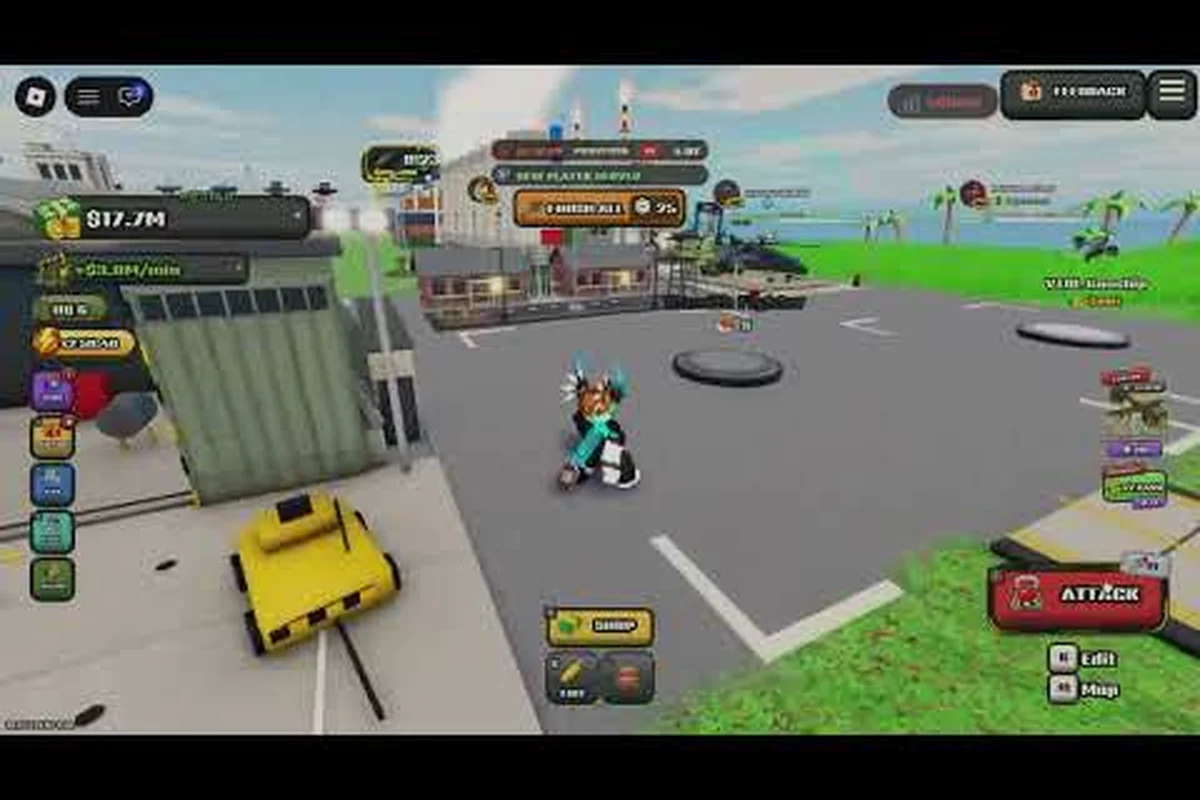
A strong World of Nukes base layout is the difference between a cramped starter camp and a superpower island that survives late-game raids. Your first placements lock in travel time, defense coverage, and how much room you have left when missiles unlock, so planning early saves hours of rebuilding.
This guide breaks down island progression from the opening camp to a fully armed fortress, with concrete placement rules, expansion timing, and the mistakes that quietly strangle your income. Every recommendation here assumes you are playing the live Roblox build, where land grows gradually and building footprints shift after updates.
Why Your First World of Nukes Base Layout Decides Everything
The island begins as a modest tropical base with limited land, and every structure you drop eats into a fixed footprint you cannot easily reclaim. That constraint is the whole game: income buildings need to sit close together so you spend seconds, not minutes, walking between collection points, while defensive structures need open sightlines around the core. Get the balance wrong at the camp stage and you will be demolishing half your island later.
According to the official World of Nukes page on Roblox, players expand land gradually rather than unlocking a full map at once. That means your World of Nukes island size is a resource you manage, not a backdrop you decorate. Treat every tile as budget.
Three principles drive every good World of Nukes best island setup: income density, defensive sightlines, and rebuild-proof spacing. Income density means packing generators and collectors into the smallest possible block so your collection loop stays under a few seconds; defensive sightlines mean keeping the outer ring clear for anti-air and shields facing the water approach; and rebuild-proof spacing means reserving empty tiles around structures whose footprints have shifted in past updates. Skip any one of these and your camp-to-superpower progression stalls — either from slow income, blind defenses, or repeated demolition costs that eat the land you fought to unlock.
-
Income first, defense second, aesthetics never — decorative clutter costs tiles you will want for missile pads later.
-
Cluster production, ring the core — generators and collectors belong in a tight block; anti-air and shields belong on the outer edge facing the water.
-
Leave a two-tile buffer around your center — updates have changed building sizes, and a buffer absorbs the shock without a full rebuild.
Community footage captured in late 2026 shows players rebuilding entire islands after a single footprint change, which is exactly the outcome a buffer prevents. If you want the broader fundamentals before diving into layout math, the island building guide covers the base mechanics that this article builds on.
Mapping World of Nukes Island Progression Stage by Stage
World of Nukes island progression runs through recognizable phases, and each phase has a different layout priority. Early on, when your island is still small and your income is capped by a handful of starter structures, the winning move is tight, defensible clustering around your core so you can protect what little you have and keep expansion cheap. As your island size grows and you push from camp toward superpower, that same compact layout becomes a liability — you need to spread high-value buildings apart, open up buildable space for new production, and re-anchor defenses around the perimeter rather than the center. Building for the phase you are in — not the phase you want — keeps your economy compounding instead of stalling, because every placement decision either supports your current income ceiling or wastes space you will have to demolish later.
The Camp Phase: Tight and Cheap
Your opening island is small enough that almost any layout works, which is precisely why players waste it. Keep every income structure within a short walk of your spawn point and resist the urge to spread out for looks. At this stage your World of Nukes building placement should favor a compact L-shape or square block, leaving the seaward side open for the first defensive unlocks.
The Outpost Phase: First Real Choices
Once land starts expanding, you face the first genuine trade-off: more income buildings or the first anti-air. Community reports consistently favor income here, because defensive structures without an economy behind them get out-scaled fast. Add one anti-air emplacement on the water-facing edge and keep everything else production.
The Fortress Phase: Defense Catches Up
By the time missile pads unlock, your island should already have a reserved outer ring. This is where the World of Nukes from camp to superpower arc pays off — players who left that ring empty slot defenses in minutes, while players who filled it with generators spend an hour demolishing.
| Phase | Land Level | Priority | Structures to Place | Structures to Avoid |
|---|---|---|---|---|
| Camp | Starter footprint | Income density | Generators, basic collectors | Decorative props, scattered defenses |
| Outpost | First expansions | Income + 1 anti-air | Collector cluster, single AA emplacement | Missile pads, redundant shields |
| Fortress | Mid expansions | Defense ring | Anti-air batteries, shields, radar | New income in the outer ring |
| Superpower | Late expansions | Layered defense | Missile pads, overlapping shields | Anything blocking sightlines |
The table above is a planning tool, not a rigid script. If your server is aggressive, pull the anti-air forward one phase; if it is quiet, push income harder. The best layout breakdown goes deeper into server-dependent adjustments.
Expanding Tiles Without Wasting Them
Expanding land is the single most consequential decision in the mid-game, because expansion is not free — it competes with building unlocks for the same resources. Players who expand blindly end up with a sprawling island and no economy to fill it.
| Expansion trigger | Tiles occupied | Income density effect | Defensive ring status | Recommended action |
|---|---|---|---|---|
| Premature | < 50% | Diluted — new tiles sit empty | Ring stretched, gaps open | Hold; unlock a building first |
| Break-even | ~80% | Neutral — one new income structure covers cost | Ring still coherent | Expand in a single direction |
| Optimal | 80% + building unlock ready | Positive — new income structure placed immediately | Ring width pre-decided | Claim tiles, drop 1 income structure, reserve rest |
| Overextended | Two expansions, no unlock | Negative — land you cannot use | Perimeter too long for emplacements | Stop expanding; fill reserve tiles with defense |
| Buffer claim | Awkward water-adjacent protrusion | None — treated as buffer, not economy | Absorbs first strike | Claim last, build no income there |
Community testing on the World of Nukes island progression consistently converges on one expansion rhythm: hold your land purchases until current tiles sit around 80% occupied, then grow in a single direction toward the water so your defensive ring stays coherent. The key insight is that each expansion should immediately pay for itself — drop one new income structure into the tight cluster on the freshly claimed tiles, and hold the remainder in reserve for defense rather than filling them with production. Players who expand twice in a row without a building unlock end up with land they cannot use, diluting income density across a sprawling island. Treat tile count as a resource that must be earned by economy, not spent ahead of it.
-
Expand only when your current tiles are 80% occupied — expansion before that point dilutes your income density.
-
Expand toward the water on one side only — a single growth direction keeps your defensive ring coherent instead of splitting it.
-
Reserve the new tiles for defense before filling them — decide the ring width first, then place production inside it.
-
Never expand twice in a row without a building unlock — you will have land you cannot use.
The World of Nukes how to expand question really comes down to pacing. Each expansion should immediately pay for itself through one new income structure placed in the tight cluster, with the remaining new tiles held in reserve. If you want a step-by-step unlock sequence that pairs with this expansion rhythm, the best build order guide maps it out unlock by unlock.
One more expansion rule worth internalizing: never expand into a shape you cannot defend. A long narrow peninsula looks impressive but forces your anti-air to cover a huge perimeter with the same number of emplacements, so a single gap in the ring lets bombers and missile units reach your income cluster untouched. Compact, roughly square footprints keep your turret coverage overlapping at the corners, while a thin strip leaves the mid-section exposed no matter where you anchor the ring. If a water-adjacent tile forces an awkward protrusion, claim it last and treat it as a buffer rather than building your economy there — the World of Nukes island size cap means every wasted tile is one you cannot reclaim later.
World of Nukes Building Placement Rules That Actually Hold Up
Placement is where most islands quietly fail — a single misplaced structure can block your entire expansion lane before you ever hit the mid-game. The rules below come from repeated community rebuilds and hold across the camp-to-superpower arc, from your first tent footprint to late-game reactor clusters. The core principle: reserve your center tiles for high-value production and keep a two-tile buffer around every structure so future upgrades and island-size increases don't force a costly teardown.
Distance and Travel Time
Every second spent walking between collectors is income lost. Keep your production block within roughly a five-second walk of your collection point, and place your highest-value structure closest to spawn. This single habit can lift your effective income by a noticeable margin without spending a single resource.
Sightlines and Overlap
Defensive structures should overlap, not sit in isolated corners. Two anti-air emplacements with overlapping coverage beat three scattered ones, because attackers route around single-coverage gaps. Place your first shield so its edge touches your second shield's edge — no dead zones, no wasted radius.
The Core Buffer
Leave two clear tiles around your island center. Updates have altered building footprints before, and community video from Zainrail's island-building series shows full rebuilds triggered by exactly this. A buffer turns a catastrophe into a minor shuffle. The reason is structural: production buildings, storage, and the spawn-adjacent collector all compete for the same inner tiles, so any footprint change to one of them cascades outward through everything you packed in tightly. Two empty tiles absorb that cascade without forcing you to demolish a working production cluster or break overlapping anti-air coverage just to re-anchor your core. Treat the buffer as reserved space, not wasted space — it costs you two tiles of layout efficiency now and saves you a full rebuild the next time a patch reshapes a building's base dimensions.
| Placement Rule | What It Protects | Common Mistake |
|---|---|---|
| Production within 5 seconds of spawn | Income per hour | Spreading collectors for looks |
| Overlapping anti-air coverage | Air defense integrity | One AA per corner, no overlap |
| Two-tile core buffer | Rebuild time after updates | Filling every tile immediately |
| Defense ring on water-facing edge | Raid approach lanes | Defending the landward side first |
| Highest-value building nearest spawn | Collection efficiency | Random placement by unlock order |
These rules interact. A tight production cluster frees the outer ring for defense, and the core buffer keeps the whole arrangement stable when the game changes underneath you. The build order reference shows how placement decisions sequence against unlock timing.
Reading Your World of Nukes Island Size Correctly
Island size is not just a number — it is a shape. Two islands with identical tile counts can play completely differently depending on how the land is distributed. A compact blob concentrates your defense and shortens travel; a sprawling archipelago spreads both thin.
Before each expansion, ask what shape you are buying. If the new land extends your existing perimeter smoothly, take it. If it creates a detached lobe you must defend separately, consider whether the income gain justifies the defensive cost. In practice, most players should favor compact growth until the fortress phase, then accept some sprawl in exchange for missile pad room.
Island size also caps your ceiling. Once you have filled your tiles with the optimal mix, further growth requires either demolition or expansion, and expansion gets expensive. That is why reserving the outer ring early matters so much — it is the cheapest land you will ever hold.
The Layout Errors That Sink Islands
Most failed islands share the same handful of errors, and each has a straightforward correction. The pattern is consistent: players expand their island size before their production chain is stable, then discover that the extra tiles sit empty while their existing buildings run at partial efficiency. A typical case is a player who unlocks a second expansion ring at the camp-to-superpower transition but has not yet consolidated their production block, so every collection cycle wastes travel time across a half-empty island. Recognizing these recurring mistakes early — scattered production, misdirected defense, premature expansion — lets you correct the layout while it is still cheap to do so.
-
Scattered production — consolidate into one block; the travel time savings compound every collection cycle.
-
Defense on the wrong side — face your ring toward the water, where raids arrive, not toward your own interior.
-
No reserved ring — if you have already filled your outer tiles, demolish the lowest-value structures there now, before missile pads unlock.
-
Expanding too early — if your current tiles are under 80% used, stop expanding and build instead.
-
Ignoring footprint changes — keep the two-tile core buffer and re-check your layout after each major update.
Fixing these early costs minutes. Fixing them at the superpower stage costs an evening. If you are still learning the building system itself, the full build guide walks through the mechanics before you commit to a layout.
Frequently Asked Questions
What is the best World of Nukes base layout for beginners?
Start with a compact production block within a five-second walk of spawn, leave the water-facing edge open for your first anti-air, and keep two clear tiles around the island center. This setup maximizes early income while preserving room for the defensive ring you will need once missile pads unlock.
How big should my island be before I start building defenses?
You do not need a specific size — you need a reserved ring. Begin defensive placement as soon as your first anti-air unlocks, even on a small island, and keep the outer tiles free. Waiting for a large island usually means you have already filled the space you needed.
Does World of Nukes building placement affect income?
Yes, significantly. Because each production cycle pays out only after a worker walks from the collection point to the structure and back, every extra tile of distance is repeated on hundreds of trips. A compact block of missile silos, reactors, and storage placed within a few tiles of your drop-off can cut each round trip to a couple of seconds, whereas a spread-out island adds several seconds per cycle — a gap that compounds into a meaningful income advantage as your world of nukes island progression accelerates. Treat distance as the hidden tax on every layout: measure it in walk time, not tiles, and keep your highest-output structures closest to the collection point.
How often should I expand my island?
Expand only when your current tiles are roughly 80% occupied, and never expand twice in a row without a building unlock in between. This pacing keeps your income density high and prevents you from holding land you cannot afford to develop.
Why do players rebuild their islands after updates?
Building footprints have shifted across past updates, so a new silo or reactor model can overlap or displace structures you already placed. A two-tile buffer around your core absorbs most of that shock: when a footprint grows by one tile on each side, the spare ring is consumed instead of crushing your production block. Community footage shows players who skipped the buffer rebuilding entire islands afterward, losing hours of world of nukes island progression. Treat the buffer as cheap insurance on every world of nukes base layout.
Bringing the Layout Together
A World of Nukes base layout that carries you from camp to superpower is built on three habits: cluster your income tightly, reserve your outer ring for defense before you need it, and keep a buffer around the core so updates never force a full rebuild. Island progression rewards patience over speed — expanding at 80% occupancy and holding land in reserve beats sprawling early every time.
Review your layout after each major update, confirm your anti-air coverage still overlaps, and keep your highest-value structure nearest spawn. Treat this as a quarterly audit rather than a one-time check: every new island size tier or building unlock can shift your threat envelope, so re-trace your anti-air umbrella radius and verify no gap opens between overlapping turrets. A concrete example: when you push from a mid-tier island to the next size bracket, your outer ring suddenly stretches, and a single repositioned SAM site can leave a blind corridor over your clustered income. Do those three things consistently — audit, overlap-check, core buffer — and your island will scale with the game instead of fighting it.